| Welcome to Sprocket School! This project is maintained by volunteer editors. Learn more about how this works. |
16mm sound formats: Difference between revisions
No edit summary |
|||
| Line 1: | Line 1: | ||
Most 16mm prints encountered in a projection setting are either '''silent''' or have '''mono optical soundtracks'''. | |||
Vintage prints with '''magnetic soundtracks''' may be projected in specialty settings, for example in a program of [https://en.wikipedia.org/wiki/Scopitone Scopitones] or at a [https://www.centerforhomemovies.org/hmd/ Home Movie Day]. | |||
Other 16mm sound formats exist, but these do not normally come up in exhibition contexts. Examples include 16mm DTS and [https://www.folkstreams.net/vafp/clips/handling-16mm-magnetic-full-coat-rolls full coat magnetic sound elements]. | |||
* | |||
__NOTOC__ | |||
==Identifying silent prints== | |||
Silent 16mm prints are easily identified because they have perforations on both edges of the film ("double perf"). Sound prints have sprockets on only one edge ("single perf"). | |||
'''Caution''': some early 16mm projectors have rollers with sprockets on both sides, and cannot be used to play back sound films. Do not use these projectors to play back a sound print; they will destroy it. | |||
<gallery widths=200px heights=200px> | |||
File:16mm Silent.png|A silent 16mm print. Note sprocket holes on both edges. | |||
File:16mm film frames.JPG|A sound print. Note soundtrack on the left side of the image. | |||
</gallery> | |||
Note that a print of a film that is known to be "a silent film" may have a soundtrack of music printed on the film! Likewise, just because a print doesn't have a soundtrack doesn't mean that the film doesn't have sound; for example, some artists' films are meant to be played with sound from an external source. | |||
==Sound from external sources== | |||
Exhibitors of ultra low budget or experimental films may encounter 16mm prints that don't have a soundtrack on the print but are meant to be projected with sound from an external source such as a digital file, cassette tape<ref>https://canyoncinema.com/catalog/film/?i=1789</ref>, radio<ref>https://web.archive.org/web/20240120092009/https://film-makerscoop.com/catalogue/barbara-rubin-christmas-on-earth</ref>, etc. | |||
==Mono== | |||
If you see an optical soundtrack on the film you're about to project, it is a mono track. (16mm stereo was developed in the 1990s, but no prints were made this way.) | |||
However, mono optical tracks can look very different from one another. Do not be alarmed. | |||
<gallery widths=200px heights=200px> | |||
File:Mauer track.JPG|A "Mauer" style mono variable area track. | |||
File:16mm-mono-single.jpg|A standard variable area track. | |||
File:16mm-scope2.jpg|A (poorly photographed) variable density track. | |||
</gallery> | |||
* Need pix of: other styles of variable area tracks, various styles of variable density tracks | |||
==Magnetic sound on 16mm== | |||
* need a projector that can do it, like some models of Kodak Pageant, some Eastmans, some Norelcos, the Kinoton FP38, some Eikis... | |||
* need photo of mag stripe sound | |||
=Gallery= | =Gallery= | ||
<gallery widths=200px heights=200px> | <gallery widths=200px heights=200px> | ||
File:16mm test film.jpg | File:16mm test film.jpg | ||
</gallery> | </gallery> | ||
==See also== | |||
*[[35mm sound formats]] | |||
*[[70mm sound formats]] | |||
-- | |||
[[Category:16mm]] | [[Category:16mm]] | ||
[[Category:Sound]] | |||
[[Category:Sound formats]] | |||
Revision as of 20:38, 16 October 2025
Most 16mm prints encountered in a projection setting are either silent or have mono optical soundtracks.
Vintage prints with magnetic soundtracks may be projected in specialty settings, for example in a program of Scopitones or at a Home Movie Day.
Other 16mm sound formats exist, but these do not normally come up in exhibition contexts. Examples include 16mm DTS and full coat magnetic sound elements.
Identifying silent prints
Silent 16mm prints are easily identified because they have perforations on both edges of the film ("double perf"). Sound prints have sprockets on only one edge ("single perf").
Caution: some early 16mm projectors have rollers with sprockets on both sides, and cannot be used to play back sound films. Do not use these projectors to play back a sound print; they will destroy it.
-
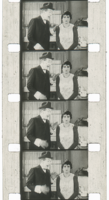 A silent 16mm print. Note sprocket holes on both edges.
 -
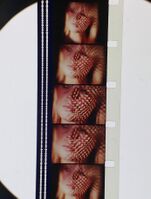 A sound print. Note soundtrack on the left side of the image.


Note that a print of a film that is known to be "a silent film" may have a soundtrack of music printed on the film! Likewise, just because a print doesn't have a soundtrack doesn't mean that the film doesn't have sound; for example, some artists' films are meant to be played with sound from an external source.
Sound from external sources
Exhibitors of ultra low budget or experimental films may encounter 16mm prints that don't have a soundtrack on the print but are meant to be projected with sound from an external source such as a digital file, cassette tape[1], radio[2], etc.
Mono
If you see an optical soundtrack on the film you're about to project, it is a mono track. (16mm stereo was developed in the 1990s, but no prints were made this way.)
However, mono optical tracks can look very different from one another. Do not be alarmed.
-
 A "Mauer" style mono variable area track.
 -
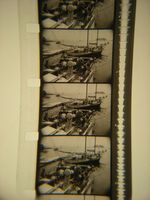 A standard variable area track.
 -
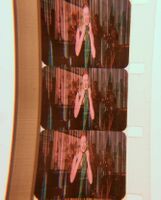 A (poorly photographed) variable density track.


- Need pix of: other styles of variable area tracks, various styles of variable density tracks
Magnetic sound on 16mm
- need a projector that can do it, like some models of Kodak Pageant, some Eastmans, some Norelcos, the Kinoton FP38, some Eikis...
- need photo of mag stripe sound
Gallery

See also
--