| Welcome to Sprocket School! This project is maintained by volunteer editors. Learn more about how this works. |
16mm aspect ratios
The 16mm frame has a native full-frame aspect ratio of ~1.34:1. This is the aspect ratio of the vast majority of 16mm prints encountered in exhibition settings today. Exceptions are usually encountered when projecting a print of a film that has been reduced to 16mm from a 35mm print, or when projecting certain experimental or artists' films.
The ~1.34:1 full-frame aspect ratio is the same for 16mm sound prints and for 16mm silent prints.
-
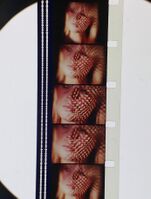 A few frames from a 16mm print of Chelsea Girls. Note the soundtrack and single sprocketed edge.
 -
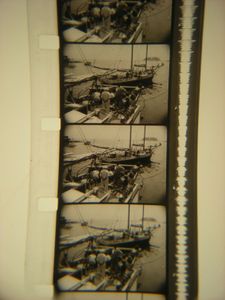
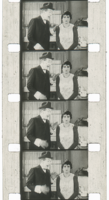 A silent 16mm print. Note that there are sprocket holes on both sides of the frame.


A brief history of 16mm reduction prints
16mm was once a common format for distribution of feature films originally released in 35mm to nontheatrical venues like schools, libraries, or television stations. Because 35mm feature films often used widescreen or anamorphic aspect ratios, 16mm reduction prints used a wide variety of methods to retain or approximate the native aspect ratios of the original 35mm prints, some more successfully than others.
Being aware of this history can help you recognize potential projection issues before they happen!
Cropping and "pan and scan"
16mm prints of feature films that were originally released in widescreen or anamorphic 35mm aspect ratios are sometimes cropped or "pan and scanned".
These appear at first glance to be normal full-frame 16mm prints, but the full widescreen or anamorphic image from the original 35mm version of the film has simply been cropped to fit into the native 16mm frame.
Though these prints may not make the film look its best, they will project normally without any special preparation. You may want to provide some context for the audience in an introduction or program notes.
Hard-matted widescreen
Other 16mm reduction prints are hard-matted to widescreen aspect ratios like 1.85 and 1.66.
The same lens and plate is used for hard matted 16mm prints, you'll just see black on the top and bottom of the image on screen (unless you get creative with masking or a zoom lens).
Anamorphic 16mm

Anamorphic 16mm prints have an aspect ratio of 2.66:1 (because of the native 1.33 aspect ratio of the frame). Note that this means that anamorphic 16mm reductions of films originally released as 35mm anamorphic will be cropped slightly at the top and bottom of the frame!
Some films, for example Love's Refrain' (2016, Paul Clipson), are natively anamorphic 16mm.
Proper projection of anamorphic 16mm prints requires an anamorphic lens.
Dual projection
Some 16mm experimental films achieve an ultra-wide screen ratio by projecting two 16mm images side by side with two different projectors. This is referred to as double or dual projection. Works that are projected this way are sometimes referred to as dual channel or two channel works, if they involve two reels of film being projected though two projectors. Works that require a single reel of film to be projected through two projectors at once (using a method similar to interlocking may be described differently: for example, Genesis 38: 14-15 by filmmaker Ayanna Dozier is described by the artist as a single loop, dual projected work.
Gallery
-
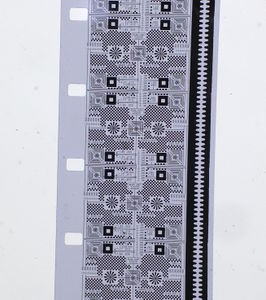 16mm test film.
 -
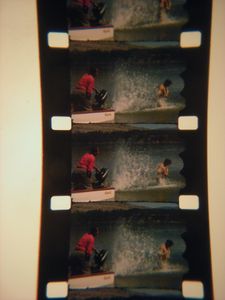 Conventional full frame 16mm print without soundtrack
 -
 Conventional full frame 16mm print with soundtrack


